
The growing incidence of surgical
errors has significantly elevated the requirement of a shift from operating
room (OR)-based training to competency-based training model. In addition, with
the lack of the traditional of apprenticeship model there is a growing
popularity of virtual reality-based robotic simulation systems among the
physicians’ community.
The healthcare sector has been
among the earliest adopters of immersive technology, as the benefits of
training students and allowing professionals to hone their skills in a safe and
realistic environment are clearly established. As a result, haptic
technology-based virtual reality robotic surgical simulators are gaining
enormous attention from major players in the industry.
To view Full Report on Robotics
Surgical Simulation Systems Market
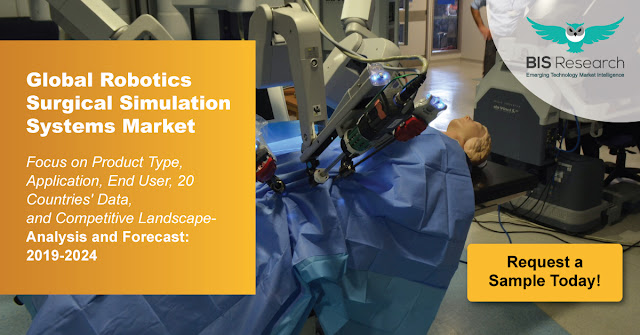
The historic growth of the market
is registered at a CAGR of 22.27% from 2014 to 2018. This growth can be
attributed to the increasing prevalence of minimally invasive surgeries, the growing
burden on economy due to surgical errors and awareness among practitioners
regarding benefits of simulation training in preventing surgical errors.
Key questions answered in the report:
§ How the role of simulation training in enhancing surgical pathways
is expected to evolve in the future?
§ Robotic-Assisted surgery is currently the leading clinical
application incorporating robotic surgical simulation. What would be the next
emerging clinical application?
§ What is the strongest return on investment due to incorporation of
competency-based surgical training over mentor-apprentice based training?
§ What are the major market
drivers, challenges, and opportunities in the global robotic
surgical simulation systems market?
§ What are the steps taken by the industry players to overcome the
challenge associated with lack of clinical data supporting the efficacy of
simulation training?
§ How the current dominating stake conquered by companies offering
robotic simulation integrated with surgical robotics, would be impacted due to
the evolving perception of end users toward the incorporation of robotics
simulation?
§ What are the key strategies incorporated by the leading players of
robotic surgical simulation systems market to sustain the competition?
§ What are the current total market size and forecasts (until 2024)
for different product categories available in the market?
About BIS Research:
BIS Research is a global B2B market intelligence and
advisory firm focusing on those emerging technological trends which are likely
to disrupt the dynamics of the market.
With over 150 market research reports published
annually, BIS Research focuses on high technology verticals such as 3D
Printing, Advanced Materials and Chemicals, Aerospace and Defense, Automotive,
Healthcare, Electronics and Semiconductors, Robotics and UAV, and other
emerging technologies.
Our in-depth market intelligence reports focus
on the market estimations, technology analysis, emerging high-growth
applications, deeply segmented granular country-level market data, and other
important market parameters useful in the strategic decision-making for senior
management.
What distinguishes BIS Research from the rest
of the players is that we don’t simply provide data but also complement it with
valuable insights and actionable inputs for the success of our clients.
Comments
Post a Comment